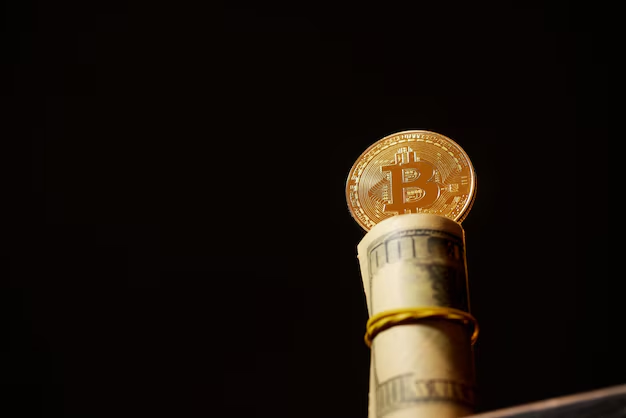
Understanding Who Owns Bitcoin: An In-Depth Exploration
Bitcoin, the pioneering cryptocurrency, has sparked a revolution in the world's financial systems. As a decentralized form of money, Bitcoin presents a myriad of questions, not least of which is: Who actually owns Bitcoin? Dive into this comprehensive guide to unravel the complexities behind Bitcoin ownership, and discover who holds the keys to the world's most popular digital currency.
Bitcoin Basics: What Is It and Why It Matters
Bitcoin operates on a peer-to-peer network, free from central banks or government intervention, allowing users to make transactions without intermediaries. This decentralized nature is what attracts many to Bitcoin. But understanding who owns Bitcoin requires grasping the foundational concepts of Bitcoin and blockchain technology.
The Blockchain: The Backbone of Bitcoin
The blockchain is a public ledger where all transactions are recorded. Each "block" contains a list of transactions, and these blocks are linked chronologically, forming a chain. This technology ensures transparency and security, as transactions are publicly available but encrypted, keeping them anonymous yet verifiable.
Anonymity vs. Transparency
Bitcoin is famous for providing a degree of anonymity. Unlike traditional financial systems, Bitcoin transactions don't require personal information, which is both a perk and a challenge. While the public address associated with each Bitcoin transaction is visible, it doesn't reveal the user's identity. This duality raises the intriguing question: Who owns Bitcoin, if traditional identifiers are absent?
Who Owns Bitcoin: The Global Picture
To answer this question, it's crucial to understand ownership distribution and control. Bitcoin ownership isn't concentrated; instead, it is dispersed among various types of investors.
Individual Investors
A significant portion of Bitcoin is owned by individual investors. These can range from tech enthusiasts who embraced Bitcoin early, to mainstream investors interested in diversifying their portfolios.
Key Characteristics:
- Tech Enthusiasts: Early adopters and miners.
- Regular Investors: Seeking potential high returns.
- Retail Traders: Actively buying and selling on exchanges.
Institutional Investors
Financial institutions, including hedge funds and publicly traded companies, increasingly hold Bitcoin as a hedge against inflation and currency devaluation.
Key Characteristics:
- Hedge Funds: Engaging in long-term investment strategies.
- Corporations: Adding Bitcoin to balance sheets.
- Exchange-Traded Funds (ETFs): Offering Bitcoin exposure to traditional markets.
Bitcoin Whales
Bitcoin whales are entities or individuals holding large amounts of Bitcoin. This group includes early Bitcoin adopters, crypto exchanges holding client Bitcoin, and investment funds.
Key Characteristics:
- Massive Holdings: Capable of influencing market prices.
- Strategic Investors: Often buy and hold for long periods.
- Market Impact: Their actions can cause significant price swings.
Factors Influencing Bitcoin Ownership
The ownership of Bitcoin is influenced by several underlying factors, shaping both the current landscape and future trends of digital currency adoption.
Legal and Regulatory Policies
The regulatory environment significantly affects who can own and trade Bitcoin. Countries with favorable cryptocurrency regulations see higher adoption levels among both individuals and institutions.
Key Points:
- Regulatory Clarity: Encourages institutional investment.
- Legal Restrictions: Can impede or encourage ownership patterns.
- Government Adoption: National cryptocurrency initiatives and restrictions impact ownership.
Technological Access and Economic Environment
Technical literacy and economic factors also play a crucial role. Regions with high internet penetration and technology adoption rates generally see higher Bitcoin usage.
Key Points:
- Internet Access: Critical for participation in the Bitcoin network.
- Economic Instability: Drives Bitcoin adoption as a hedge.
- Public Perception: Public understanding impacts ownership growth.
Challenges in Determining Bitcoin Ownership
While the blockchain provides transaction transparency, determining exact ownership remains complex due to several challenging factors.
Pseudonymous Nature
Bitcoin addresses don't tie directly to personal identities, reinforcing anonymity but complicating ownership tracking.
Wallet Security
Ownership is often guarded by private keys. The loss of these keys results in irretrievable Bitcoin, affecting the actual circulating supply compared to perceived ownership.
Market Complexity
Market mechanisms and transactions, like derivatives or lending, obscure true ownership patterns, adding layers of complexity to ownership data.
Visual Insight: A Snapshot of Bitcoin Holdings
For clarity, here's a summary of key Bitcoin ownership categories:
| Category | Description | Impact |
|---|---|---|
| Individual Investors | Varied, from enthusiasts to regular investors | Broad market support; diverse adoption rates |
| Institutional Investors | Includes funds, corporations, and ETFs | Stability and market validation |
| Bitcoin Whales | Large holders with significant market influence | Potential for price manipulation |
Conclusion: The Future of Bitcoin Ownership
Bitcoin ownership spans a diverse spectrum, from individual enthusiasts to major institutional investors. As regulations evolve and new investment vehicles emerge, Bitcoin's ownership landscape will continue to transform, possibly becoming more democratized and mainstream.
Understanding Bitcoin's ownership involves recognizing the unique structures and challenges inherent in decentralized finance. As you explore the world of cryptocurrencies, consider the roles of transparency, privacy, and market dynamics in shaping who owns Bitcoin today and in the future.
🔑 Key Takeaways:
- Diversification: Ownership is widespread, from individuals to corporations.
- Market Influence: Whales hold power but new investors bring stability.
- Regulatory Impact: Rules and public perception shape ownership trends.