Can You Pay Your Car Payment With a Credit Card? What You Need to Know
The short answer: it depends on your lender and the payment method they accept. Some auto lenders allow credit card payments directly; others don't. Even when it's possible, whether it makes financial sense is a separate question entirely. Let's walk through how this actually works.
How Car Payments Typically Get Made
Most car loans are set up to accept payments in a few standard ways: direct bank transfers (ACH), checks, automatic deductions from a bank account, or online payment portals that connect to your checking account. These methods move money directly from your bank account to your lender.
A credit card payment, by contrast, involves a third party—the credit card company—stepping in between you and your lender. Some lenders have integrated systems to accept credit card payments directly through their website or app. Others simply don't offer this option at all, either because of their payment infrastructure or as a deliberate business decision.
When Credit Card Payments Are Actually Possible 📳
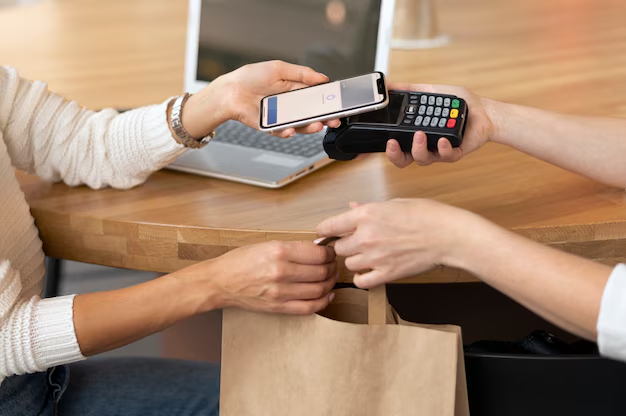
Direct payment through the lender's system. Some auto finance companies—particularly larger national lenders—now accept credit card payments directly on their website or mobile app. You enter your card details and make a payment just like you would with any online purchase. The transaction is processed as a normal credit card charge.
Third-party payment platforms. Even if your lender doesn't accept cards directly, you might use independent bill-payment services (often tied to your bank or available online) that let you pay almost any bill with a credit card. These services act as an intermediary, charging your card and then sending the funds to your lender via traditional banking channels. However, these platforms may add transaction fees for this convenience.
The key variable: your specific lender's policy. Before assuming you can pay with plastic, you need to check with your auto finance company directly.
The Real Cost: Why Credit Card Payments Often Don't Make Sense 💰
This is where the math gets important. Even if you can pay your car loan with a credit card, you usually shouldn't—unless you have a very specific reason.
Credit Card Processing Fees
Most payment processors charge a transaction fee when you pay a bill (including a car loan) with a credit card. These fees typically range from 2% to 3% of the payment amount, though the exact percentage varies by processor and payment method. On a $400 car payment, a 3% fee means you're paying an extra $12 just to use your card.
Over a car loan term that could add hundreds of dollars in fees that you wouldn't pay using a direct bank transfer.
Comparing the Interest Rates
Here's the core financial tension: if you're paying a car loan at a typical auto loan interest rate (which might range from low single digits to double digits depending on your credit and the loan terms) and you're carrying a credit card balance, you're almost certainly paying a higher interest rate on the card than on the car loan.
The math strongly favors paying the car loan with money from your checking account—not your credit card balance. If you're using a credit card to borrow money to pay the car (meaning you'll carry a balance), you're essentially taking a higher-cost loan to pay a lower-cost loan.
When It Might Make Sense
There are limited scenarios where credit card car payments could align with your strategy:
You're earning substantial rewards. If a rewards credit card offers 2% or higher cash back or points, and the payment processor doesn't charge a fee (or charges less than your rewards earn), there's a small window where it pencils out. But this is rare and requires careful math.
You're paying it off immediately. If you have the cash in your checking account and are paying the balance in full on your credit card each month, you might use a rewards card without carrying any balance. The rewards offset the transaction fee—but again, only if there is no fee or if rewards exceed it.
You need to float the payment briefly. Some people use a credit card to time a payment strategically (perhaps getting a few extra days before the card bill is due while the lender clears the transaction). This only works if you plan to pay the card in full and won't incur interest charges.
In nearly all other situations, paying with a direct bank transfer is cheaper.
What Actually Happens When You Pay With a Credit Card
When you do make a car payment with a credit card:
- Your credit card is charged the full car payment amount (plus any transaction fee, if applicable).
- The payment processor sends funds to your auto lender, typically within 1–3 business days.
- Your car loan account is credited with the payment.
- Your credit card bill arrives at your regular billing cycle and must be paid by your card's due date.
Important distinction: Paying your car loan with a credit card doesn't change your car loan. You still owe the same principal and interest; you've just used a different funding source. Your credit card company doesn't have any claim to your car—the auto lender still holds the lien.
If you carry a balance on the credit card after making the car payment, you'll owe interest on that balance at your card's APR.
Key Factors That Determine Your Options
| Factor | Impact |
|---|---|
| Your lender's policy | Some accept cards directly; others refuse them entirely. This is the gatekeeper. |
| Payment processor fees | Transaction fees (typically 2–3%) add real cost to each payment. |
| Your credit card rewards | Only valuable if rewards exceed any transaction fees and you pay the card in full monthly. |
| Your credit card APR | If you carry a balance, you're borrowing at a rate likely much higher than your car loan rate. |
| Your available cash flow | Can you pay off the card balance immediately, or would this create debt? |
Questions to Answer Before Paying Your Car With a Card
Before you attempt this, here's what you need to know:
Does your lender accept credit card payments? Call or check your online account to confirm they offer this option and ask about any fees.
What's the transaction fee, if any? Ask directly. Some lenders charge; others don't. Some third-party processors charge; others don't.
What's your credit card APR? Compare it to your car loan rate. If it's significantly higher, the math works against using the card as a funding source.
Can you pay the full credit card balance immediately? If not, you'd be paying credit card interest on top of your car loan payment—a double cost.
Are you chasing rewards, or avoiding your checking account? Honestly assess whether the rewards (if any) justify the fee and complexity, or whether there's an underlying banking issue you should address directly.
The Bottom Line for Your Decision
Credit card payments for car loans are technically possible at some lenders but financially problematic for most people. The combination of transaction fees and higher credit card interest rates makes this an expensive way to pay unless you can genuinely profit from rewards and pay the card off immediately.
Your circumstances—your lender's policy, your available cash, your credit card rewards structure, and your ability to pay the card in full—all determine whether this option is worth exploring. For the vast majority of borrowers, a direct bank transfer from checking remains the simplest, cheapest way to pay a car loan on time.