Understanding the K-1 Tax Form: What It Is and How It Affects You
When tax season rolls around, the daunting task of sorting through paperwork begins for many. Among the pile of forms, you might come across a K-1. But what exactly is a K-1 tax form, and why should you pay attention to it? Whether you're a new investor, a partner in a business, or someone with trust income, understanding the K-1 can be crucial for accurately reporting income and staying compliant with tax regulations.
What is a K-1 Tax Form?
The K-1 Tax Form, also known as Schedule K-1, is a tax document used to report income, deductions, and credits from partnerships, S corporations, estates, and trusts to the IRS. Unlike traditional salaried employees who get a W-2 form, individuals involved in these entities receive a K-1 that reflects their share of the income generated.
Why is the K-1 Important?
The K-1 is essential because it informs both the entity and the individual of their taxable income derived from the entity's activities. This income must be reported on the individual's tax return, similar to income reported on a W-2. However, the timing and structure of a K-1 can vary, making it critical to understand its specifics.
Types of K-1 Forms
- Form 1065 - U.S. Return of Partnership Income: For partnerships, used to report each partner's share of income.
- Form 1120S - U.S. Income Tax Return for an S Corporation: For S corporations, providing each shareholder's share of income.
- Form 1041 - U.S. Income Tax Return for Estates and Trusts: For beneficiaries of estates and trusts, detailing income shares.
How Does a K-1 Impact Your Taxes?
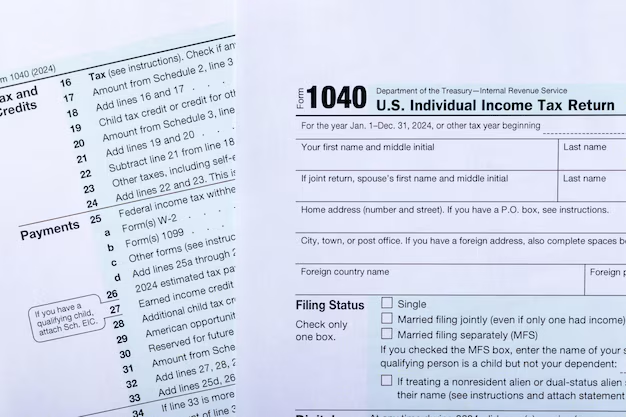
The K-1 form integrates with your personal tax return. For instance, when you receive a K-1 from a partnership, it reflects your proportional share of business income, losses, and other tax items. This information is crucial for Form 1040, which is your individual income tax return.
Reporting K-1 Income
- Ordinary Business Income: Usually reported on Form 1040, Schedule E.
- Interest and Dividends: Directly transferred to the Income Section of Form 1040.
- Capital Gains: Recorded in Schedule D.
- Deductions and Credits: Applied on the respective part of your tax return.
Timing and Deadlines
Entities that provide K-1s typically must submit their returns, which include issuing these forms, by March 15th for corporations and April 15th for most other entities. However, K-1s often appear later due to the complexity of calculations, which can delay your tax filing.
📌 Quick Tip:
- Stay Organized: Keep all financial and investment documents handy. Delayed K-1s might mean you need to file for an extension on your tax return using Form 4868.
Key Elements of the K-1 Form
A K-1 is packed with numbers and codes, but understanding its structure can simplify the process.
Sections of a K-1
- Identification Information: Includes details about the partnership or S corporation and the individual taxpayer.
- Income/ Loss Information: Breaks down the taxpayer’s share of income, such as ordinary income, rental income, or interest.
- Other Information: Provides additional details, like foreign transactions or tax-exempt income.
Decoding the Boxes
Each box in a K-1 carries different tax implications. Here’s a quick overview:
- Box 1: Ordinary business income or loss.
- Box 2: Net rental real estate income or loss.
- Box 3: Other net rental income.
- Boxes 5-8: Dividends and royalties.
- Box 9a: Special allocations might be noted here, including guaranteed payments or ownership changes.
Dealing with Errors or Discrepancies
Errors on a K-1 can be stressful, but they're not uncommon. Discrepancies might arise from miscalculations or misunderstanding the allocations.
Steps to Resolve K-1 Issues
- Review: Cross-check the allocations and calculations.
- Contact the Issuer: Reach out to the partnership, corporation, or trust for clarification.
- Seek Professional Help: Hiring a tax professional can ease the burden and enhance accuracy.
⚠️ Caution:
- Reporting an incorrect K-1 can lead to audits or penalties. Accuracy is crucial!
Implications for Different Stakeholders
For Investors
If you're an investor in a partnership or an S corporation, the K-1 provides a transparent view of your investment returns. Make sure to align it with your financial strategy and tax planning for optimal benefit.
For Business Owners
Business owners in partnerships or S corporations find K-1s crucial for tracking individual liabilities and ensuring all parties accurately report income.
For Estate Beneficiaries
Beneficiaries of an estate or trust listed on a K-1 should coordinate with the estate's executor to guarantee all income is correctly reported, minimizing tax liability.
Frequently Asked Questions about K-1
Why did I receive a K-1?
You received a K-1 because you are a partner, shareholder, or beneficiary in an entity that earned income that must be reported to the IRS.
Can a K-1 affect my tax bracket?
Yes, the income reported on your K-1 is added to your other earnings, which could push you into a higher tax bracket, affecting overall tax payment.
What should I do if my K-1 is late?
Consider filing for an extension. It's common for K-1s to be delayed due to intricate calculations required for their preparation.
Is a K-1 the same as a 1099?
No, a K-1 reports pass-through income from partnerships, whereas a 1099 reports independent contractor income.
What if I didn’t receive income from the entity?
Even if no distributions are made, income or losses might still be reportable on a K-1, affecting your tax responsibilities.
K-1 Tax Form Summary Highlights
- 📜 Definition: A document reporting an individual's share of income from partnerships, S corporations, estates, or trusts.
- 📅 Timing: Usually issued by March 15 for corporations; can delay individual tax filings due to its complex nature.
- 📈 Reporting: Ensures the taxpayer reports all income accurately on their IRS Form 1040.
- ⚠️ Issues: Common to face delays or minor errors; essential to verify and correct before filing.
In the ever-evolving world of taxes, the K-1 provides a glimpse into income derived from collaborative entities. Understanding its implications and mechanics will empower you to manage your tax obligations with greater ease, safeguarding financial well-being and compliance with tax regulations. Stay informed, organized, and proactive in dealing with every K-1 you encounter!
Discover More
- Am I Tax Exempt
- Are 401k Contributions Tax Deductible
- Are 529 Contributions Tax Deductible
- Are 529 Plan Contributions Tax Deductible
- Are Association Fees Tax Deductible
- Are Attorney Fees Tax Deductible
- Are Campaign Contributions Tax Deductible
- Are Charitable Donations Tax Deductible
- Are Church Donations Tax Deductible
- Are Churches Tax Exempt